


Fantastic Planet: The World Beyond Human Scale


Fantastic Planet. Image from Janus Films. Editorial title treatment by Otherworlds Inc.
A woman carrying her baby runs up a dark slope. Two blue fingers rest near the top. One reaches out, and she tumbles back down. Sitting at the bottom, she lifts the baby in front of her.
It’s that last gesture that makes the fall hurt. She has two bodies to get uphill and only her own legs to do it. Before she can try again, she has someone to look after. The little interval in which she can give the baby her attention feels precious. There’s a whole relationship here that the pursuer has no share in.
René Laloux’s 1973 animated film Fantastic Planet gives the hill two very different meanings. On Ygam, humans called Oms live among the giant Draags, who sometimes keep them as pets. You could draw a map of the slope to scale, put each body in its proper place and still miss what it costs to get from the bottom to the top. For that you need time, and Laloux makes time for another climb.
The second climb
The fingers are waiting when she gets back. Again she rolls downhill. On a third approach she enters low on the right, with the hand already planted above her.
The first touch comes as a surprise. The second time, there’s an awful chance to anticipate it. You can see how little farther she needs to go, and how little her pursuer would have to do to let her past. Simply lifting a hand would be enough. For her, all the effort in the world might still leave her exactly where she started. There’s a cruelty particular to a game that only one player has the power to quit.
Eventually a wider view shows three Draag children bending over the ground. Imagine beginning there. You might wonder which child thought up the game, who is going along with it, whether one of them will intervene. By beginning within the woman’s reach, the film gives us a different loyalty. We have already had reason to hope she can get a foot past that finger. The wider view arrives after that loyalty has already taken hold.
Drawing the distance
Roland Topor supplied the original drawings. Josef Kábrt worked on the characters, Josef Váňa on the backgrounds. The Prague animators could draw, color and cut successive poses to carry a figure through a movement. There’s something worth appreciating in that division of labor here. A background artist’s incline can give a character’s bent knee a reason to bend. A change in the angle of that knee can make a slope we know is drawn feel suddenly difficult to climb.
Topor told Le Monde in 1973 that fiction needed recognizable characters to reach its audience. The odd pleasure of that idea on Ygam is how much recognition a single finger will do. Most of us know what it feels like to nudge something out of the way. For once, we also have an unusually good idea what it feels like to be on the receiving end. It’s an uncomfortable bit of casting. There’s a part for the viewer on either side of the gesture.
Inside the curve of a hand
Look again at the image above. A Draag looks down at a small figure, its back to us, within the curve of one hand. It’s easy to read affection into that pose. It asks so little of us to do so. The larger face gives us a gaze to follow, and the smaller figure gives that gaze a destination. Try the more difficult exercise of imagining what the little one can see from there. An expression that looks gentle from across the picture might be too large to take in all at once.
A hand makes a fine shelter until the person inside it wants to go somewhere else. That possibility belongs in even the fondest reading of the image. There’s room to imagine the Draag opening its fingers. The decision about when to open them would still belong to the Draag.
From our worlds: Glacias
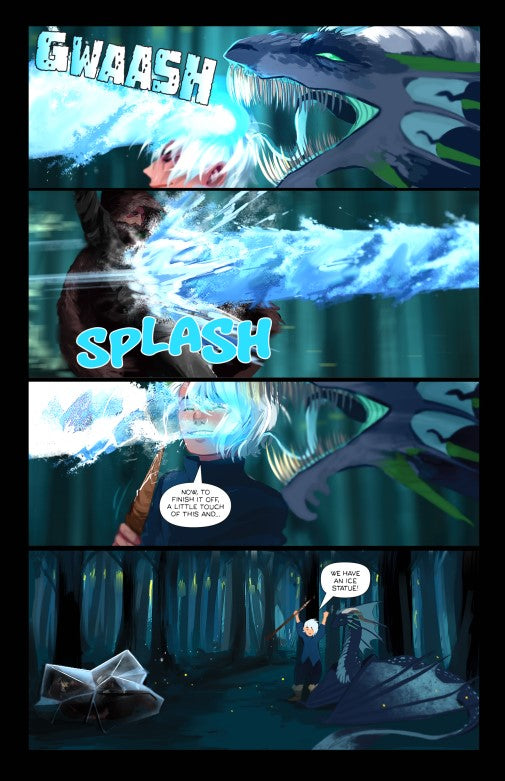
There’s a lovely test of that reading in Glacias. Lyth, a water dragon, opens wide and sends water toward a bear. Juka stands close beside those jaws. The last panel leaves the ice-encased bear on the left and the boy and dragon together on the right. Follow the direction of the water and you can see why Juka can stand so close. Lyth’s reach extends past him, toward a danger they face together. The pleasure of the page is finding a safe place for the boy exactly where a stranger might think it most dangerous to stand. That is a fairly precise thing to say about a friendship without asking either friend to explain it.
The width of a path

One more image from Fantastic Planet gives the eye a choice. Two tall figures share a broad path above clusters of much smaller figures. Start with the pair and there’s an expanse fit for a leisurely walk. Start below and the eye keeps stopping to pick out individuals. There is a little work involved in seeing a crowd as people, especially when the taller pair are so easy to tell apart.
Give one of those small figures a moment longer. Choose a neighbor it might want to reach. Now a patch of ground that seemed scarcely worth drawing has somewhere to set out from and somewhere to go. That possibility was there even when you could take in the whole path at a glance. The distance gets interesting as soon as somebody has to cross it.
Sources and scope
This essay examines the opening excerpt and selected distributor artwork. It does not offer a complete plot reading.
- Opening excerpt — Transmettre le cinéma
- Film credits — The Criterion Collection
- Promotional artwork — Janus Films
- Animation technique — Les enfants de cinéma, pp. 2 and 8
- Czech production credits — Masaryk University / University of Łódź
- Glacias creator credits — Otherworlds Inc.
- Contemporary creator testimony — Le Monde, November 30, 1973
Film imagery is included for identification and critical commentary. Rights remain with the respective creators and rights holders. Glacias artwork is provided by Otherworlds Inc.
Continue Exploring
Two more ways artists give imagined worlds a life of their own.

