



Hades: Why Failure Keeps the Story Moving


Hero art: Hades © Supergiant Games. Official promotional screenshot; editorial crop and title treatment by Otherworlds Inc.
Spoiler note: This feature discusses the original Hades, its early characters, and one example of dialogue responding to upgrades. It avoids endings and major story revelations.
An escape attempt can end with plenty left unfinished: a route still to learn, a fight still to understand, somewhere Zagreus has yet to reach. In Supergiant Games’ Hades, that failure sends him back to the House of Hades. The next attempt will demand more fighting. First, though, he returns to people who know him.
That small distinction gives the game much of its narrative force. A new attempt belongs to an ongoing life. Encounters can leave something behind in the way characters speak, even when the immediate effort ends in defeat. The story has room to consider what happened before asking Zagreus to go again.
Repeated play creates an awkward problem for a storyteller: an encounter may need to remain available long after its first dramatic introduction. Familiarity can drain a confrontation of meaning. Hades finds possibilities inside that familiarity. Its recurring characters can have pride to protect, encouragement to offer, or their own interpretation of an event. The return becomes a social occasion, with all the warmth and discomfort that coming back can carry.
A rival who has something to say about winning
Consider a developer example involving Megaera and the Mirror, the system through which Zagreus can gain lasting strength. In a June 2021 Nintendo interview, writer and creative director Greg Kasavin describes Megaera attributing a victory over her to those upgrades. The interview also illustrates a different response for defeating her without them. The circumstances of a win can become part of the conversation.
The distinction gives a mechanical choice a social consequence. An upgrade changes Zagreus’s capabilities, but Megaera can also use it to explain away his achievement. Her response suggests pride at work: winning the fight does not automatically grant him control over what the victory means.
Recognition, here, can arrive as resistance. A character need not congratulate the player to acknowledge what happened. By allowing an opponent to interpret the result, the writing gives her a stake in the encounter beyond its function as an obstacle.
There is a useful craft question inside this: what would a character notice, and what would they rather explain away? Those are different questions from what information the audience needs. A scene built around both can communicate an event while revealing the person speaking. The facts become something contested between characters, with room for vanity, affection, defensiveness, or a stubborn refusal to concede.

The different voices waiting at home
A return after defeat also needs a rhythm. In his September 5, 2021 interview with Tom’s Guide, Kasavin describes several complementary responses: humor through Hypnos and Skelly, reassurance through Achilles and Nyx, and the possibility of becoming stronger through the Mirror. These are different ways of meeting the same setback. One offers a laugh, another company, another something practical to do.
That variety matters because a single emotional instruction would soon become tiring. Relentless sympathy could make every defeat solemn; relentless mockery could turn the return into another punishment. Kasavin’s account describes a place with several registers, allowing the pace to shift after combat.
Someone frustrated by a fight may welcome a joke or have little patience for one. Still, the design makes room for responses beyond the verdict of the battle itself. Failure is allowed to occupy a smaller part of the scene.
A recurring home offers an unusual kind of dramatic space. In a journey organized entirely around departure, places left behind can become completed chapters. A home revisited remains available for unfinished business. Its familiarity gives the writer somewhere to place a change small enough to be lost in a new location: a different tone, a withheld kindness, a conversation that now has another subject.
For creators, this suggests a practical way to develop a setting. Before adding another room or another page of history, consider who will be there the next time the protagonist arrives. What do they remember? What do they want to discuss? A location becomes part of a relationship when returning to it involves facing someone.
The work inside a responsive line
The apparent attentiveness of Hades has a concrete writing process behind it. Speaking to GeekDad in October 2019, during Early Access, Kasavin explained how authored dialogue could be selected according to conditions such as health, location, and earlier encounters with gods. His example involved Aphrodite responding in relation to an earlier encounter with Athena.
His account shows the underlying craft: the response is written in advance, and the game needs to recognize when it belongs. What sounds like a character noticing the situation depends on someone anticipating that situation and giving the character suitable words.
Selection also becomes part of characterization. The available facts do not all deserve equal attention. A useful response brings a particular character’s interests into contact with the present moment. It gives the player a reason to believe that this person, with these concerns, would say this now.
Authorship continues beyond the page. The Academy of Interactive Arts & Sciences credits identify Kasavin for writing, Jen Zee for art direction, and Darren Korb for his performance as Zagreus. Those roles sit within a wider studio effort. A recurring character needs a recognizable presence across words, image, and voice; continuity is something several disciplines help sustain.
In a February 2021 interview with Echoes and Dust, Korb discusses responsibilities spanning music, sound effects, and voiceover. His initially temporary performance as Zagreus became the final role after auditions, while Kasavin handled dialogue implementation. The account makes the collaboration tangible: writing a line, speaking it, recording it, and arranging for it to appear are related jobs with different demands.
A performance can give an acknowledgment its temperature. A sentence that merely records an event on the page can become amused, weary, or guarded when spoken. Implementation must then place that performance where it makes sense. The impression of a continuous person depends partly on these pieces reaching the audience together.
There is a less glamorous production detail worth keeping beside that achievement. In a September 2021 conversation with The Outerhaven, Kasavin recounts Korb getting microphones to actors so recording could continue during the pandemic. The voices waiting in an imagined home depended on equipment reaching people in their real ones. It is a reminder that responsiveness on screen is supported by practical coordination, as well as the more visible work of writing and performance.
For a storyteller working at a smaller scale, the useful ambition is specificity. Choose an event the audience will remember, decide who cares about it, and let that concern affect a later scene. Even a brief acknowledgment can carry weight if it belongs to the character. The challenge is making the connection feel worth hearing.

Repetition still asks for your time
None of this makes repeated attempts costless. In his Game Informer review, Matt Miller praises the connection between combat and story while also criticizing repetition that delays the closure he wants. His assessment identifies a limit to the design’s appeal: a player can care about what comes next and resent the work required to reach it.
That objection belongs inside the argument for Hades. Narrative continuity can give a return significance without making every repeated battle equally welcome. Interest in a conversation and appetite for another combat attempt are different resources. When they fall out of step, a compelling story may make the wait more noticeable.
There is practical help for combat difficulty. Supergiant’s FAQ explains God Mode as damage resistance that grants further resilience after deaths. It does not make Zagreus invulnerable. It can ease combat pressure, while leaving other sources of friction—repetition, pacing, or the time a player has available—relevant. Using that option is a reasonable way to shape the experience around what someone wants from it.
The distinction is useful when discussing games with a strong story: the wish to continue and the ability to continue deserve separate attention. A thoughtful response to failure can help sustain the first. The demands of play still determine much of the second. Neither cancels the other.
From our worlds:
A World Big Enough for the Ones We Love
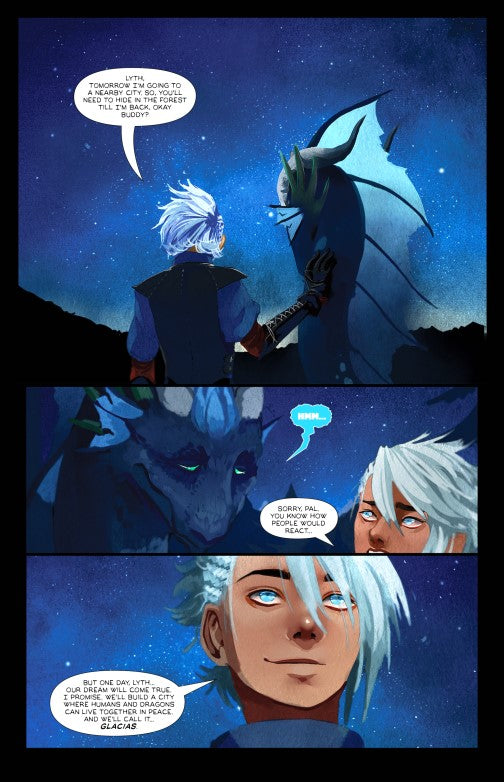
In the publisher preview of Glacias, Juka asks his water-dragon companion, Lyth, to hide outside the next city. He apologizes, then promises a future city where humans and dragons can live together. The ambition is large; the immediate request is painfully small. For now, someone he cares about must wait outside.
That gap gives the promise weight. Coexistence has a particular face beside Juka, and the journey carries an obligation to that companion. The scene leaves the desired world unfinished while showing what its absence costs their relationship.
It offers a connection to Hades through the people who give movement a purpose. An interrupted journey can still hold a promise; reaching somewhere matters partly because of whom we hope to bring with us.
Glacias is written by Yaruno, with art by Nawa, and published by Otherworlds Inc. Explore their story in Glacias Issue 1–2.
What survives the attempt
A story built around repeated encounters has to decide what repetition will preserve. It can preserve only the obstacle, leaving the characters to perform the same introduction again. Or it can preserve a history between them, giving the next meeting something to inherit.
Hades makes that history part of its appeal. A rival has an explanation for losing. Someone at home can offer another response to defeat. The writing, performance, and design give those encounters ways to acknowledge a life already in progress.
The next escape still requires effort. Yet the return has a value that can exist before another attempt succeeds. Zagreus comes back with something that happened to him, and the story has made room for someone to answer.
Sources & art credits
Developer accounts and criticism are linked beside the claims they support. Those source pages may reveal more than this article does.
Hades images are official Supergiant Games promotional materials used to discuss the game’s design and creative work. Rights remain with Supergiant Games and the respective creators. Glacias is written by Yaruno, with art by Nawa, and published by Otherworlds Inc. Contact Otherworlds Inc. for credit corrections or rights concerns.
Continue Exploring
Discover how games make curiosity and care part of the player’s experience.

