



Citizen Sleeper: When Survival Takes All Your Time


Hero art: Official Citizen Sleeper key art via Fellow Traveller. © Jump Over the Age; published by Fellow Traveller. Editorial crop and title treatment by Otherworlds Inc.
Early-game spoilers for the original Citizen Sleeper (2022).
Suppose you have one good die left. You could spend it on work, giving yourself a better chance of earning what you need. You could put it toward exploring the station, or a task that matters to someone you have met there. Each option is available. Only one gets the die.
That small decision carries much of Citizen Sleeper. In the original 2022 role-playing game from Jump Over the Age, you begin each cycle with a rolled hand of dice to assign to actions. The day arrives with a visible limit. Before deciding what kind of life to build, you have to decide how much of it you can afford to attempt.
You are a Sleeper: a digitized human consciousness in an artificial body, escaped from corporate ownership and trying to survive on Erlin’s Eye, a space station. Freedom has brought you somewhere new. Your body still needs maintenance, and getting through the next cycle can consume the means to do anything else.
This pressure changes as the game develops. Learning its systems and gaining resources can make survival much easier. That change matters to its story of freedom: having options becomes a different experience when something is left after paying to stay alive.
Your body determines the budget
The distinction between condition and energy is essential. Food restores energy. Stabilizer restores condition. Depleted energy can cause further condition loss, while deteriorating condition can reduce the number of dice available to you. These needs feed into one another, but they require different kinds of attention.
A meal therefore does something practical for the future. It helps prevent another source of deterioration. Maintaining condition protects the capacity with which you will face a later cycle. The reward for taking care of yourself may be the continued ability to act, something that is easy to overlook when progress is usually measured in newly acquired powers.
Consider what losing a die means. There might still be work available, an unexplored location and a person whose story you want to follow. The game has not necessarily removed those possibilities. Your ability to pursue them has shrunk. An unchanged menu can conceal a substantial loss of freedom.
That is a sharp way of making exhaustion legible. An unfinished task can look like a statement of priorities: you chose something else, so perhaps you cared about it more. Here, the limited hand makes another explanation visible. You may care about several things and lack the capacity to do them all. Postponement carries less certainty about a person’s values than it first appears to.
Gareth Damian Martin has connected this design to experience of gig work, describing the dice in terms of how much someone can offer during a day. Martin’s interview with Game Developer traces that connection. The mechanics give that idea a consequence beyond atmosphere. A setback can affect the resources with which you meet the next setback. Protecting tomorrow’s hand becomes part of today’s work.
Work, food and the cost of getting oriented
Early work for Dragos at the scrapyard brings the loop into focus. Salvage offers a way to earn currency, and its actions can carry bodily risk. A successful job helps fund your needs. A bad result can leave you having to address another problem with the capacity that remains.
The strongest die in your hand consequently has more than one value. It is an opportunity to act, and it can make a chosen action more dependable. For ordinary dice actions, die values and relevant skills affect the chances of positive, neutral and negative outcomes. The risks attached to an action matter too. Deciding where to put a strong die means deciding which uncertainty you most need to reduce.
Spend it on earning, and another task must get a weaker die or wait. Spend it elsewhere, and the work may become a less reliable way of meeting your needs. The significance lies in that connection between decisions: securing one part of the day changes what you can offer the rest.
The Bright Market makes even finding your way into an activity. Its interface offers asking for directions and exploring the market, with action odds and a Local Knowledge progress clock. Being surrounded by possibilities does not mean you already know how to use them. Orientation takes effort.
Exploration also leads to Emphis’s food stall, where an introductory free taste precedes later paid meals that restore energy. The early food sequence makes discovery part of meeting a basic need. This gives the station a useful specificity. Somewhere to eat has to become known to you. Gradually, a strange place acquires practical landmarks: here is work; here is food; here is something worth returning to when the immediate problem has been handled.

Some clocks measure what you are building
The circular clocks could easily suggest a station full of deadlines. They serve several purposes, however. Some record progress you make through actions; others track developments in the surrounding world. A filling circle can represent effort accumulating, as well as an event drawing closer. The official description distinguishes these uses.
This distinction gives time texture. A project can need repeated attention. Something else can require waiting. Another development can make delay costly. Reading which kind of clock you are dealing with is part of learning to live on the Eye. A full schedule does not make every demand equally urgent.
Progress clocks also let a modest action belong to something larger. You may be unable to finish a task now, but you can contribute to it. Across cycles, that creates a form of commitment built from return visits and partial efforts. It allows a story to register persistence without demanding that every day contain a decisive breakthrough.
There is tactical room within a poor hand, too. Hacking uses matching values, so a low die can have a useful destination. Launch coverage notes this useful role for low rolls. Recognizing that use changes the question from how disappointing a roll looks to what can be done with it. Scarcity asks you to learn distinctions, not simply endure a smaller number.
Those distinctions keep the system from making one undifferentiated claim that life is hard. It matters whether you need a safer outcome, another action, more information or time for a process to finish. Each shortage creates a different decision.
What happens when survival gets easier?
The game's opening pressure does not describe every later cycle. Jody Macgregor’s launch review for PC Gamer records survival becoming substantially easier as resources accumulated and the systems became familiar. His review is a useful counterweight to an account of permanent scarcity. That is one documented trajectory, rather than a timetable every player will follow.
Progression can alter the limits themselves. The original game's skills include perks for self-repair, retaining dice despite poor condition and rerolling dice. The hand you begin with is a starting situation whose constraints can change. Skills and their benefits affect how much control you have over the day, as well as how effectively you perform a particular action.
This relief deserves room in any account of the game's argument. If the dice always represented unrelenting deprivation, endurance would threaten to become the only available achievement. Instead, greater security can change what an action is for. A die that once had to support immediate upkeep can become an investment in a chosen project.
Martin describes the narrative as interwoven character arcs whose focus the player helps determine. Martin’s interview with Inverse discusses that structure. With more breathing room, selecting among those arcs can express curiosity or attachment more fully. The people were already there. Your capacity to follow through has changed.
Reduced pressure may also make the daily loop less tense. A player drawn chiefly to difficult resource decisions could miss the earlier friction. The quieter stretch carries another possibility, though: discovering what receives your attention when an emergency no longer assigns it for you. Having enough can reveal a preference that having too little kept postponing.
The people behind the numbers
The visible economy of dice and clocks is a set of authored choices. Gareth Damian Martin designed, built and wrote Citizen Sleeper, also creating its 3D art and interface. Guillaume Singelin made the character art; Amos Roddy supplied sound and music. In an Origin Story interview, Martin explains the importance of placing the player within a particular social position. The limits of that position give the choices their weight.
Singelin’s process adds a useful physical detail. Martin’s account of the Sleeper’s Archive describes digital character sketches followed by final linework inked in pen. Behind the figures encountered through an interface are drawings with an existence on paper: individual marks made for individual people.
That specificity matters alongside the game's abstractions. A clock divides an undertaking into units; a portrait gives the person associated with it a particular presence. Both forms are necessary to the effect. The interface makes a commitment manageable, while the character art gives the player someone to associate with the effort.
Roddy’s original soundtrack release credits him with writing, producing and recording the music. The work brings those contributions together around a deceptively simple action: choosing where a die goes. Writing supplies the situation, the interface exposes its limits, and the drawn characters give those decisions faces.

From our worlds: a city with room for a friendship
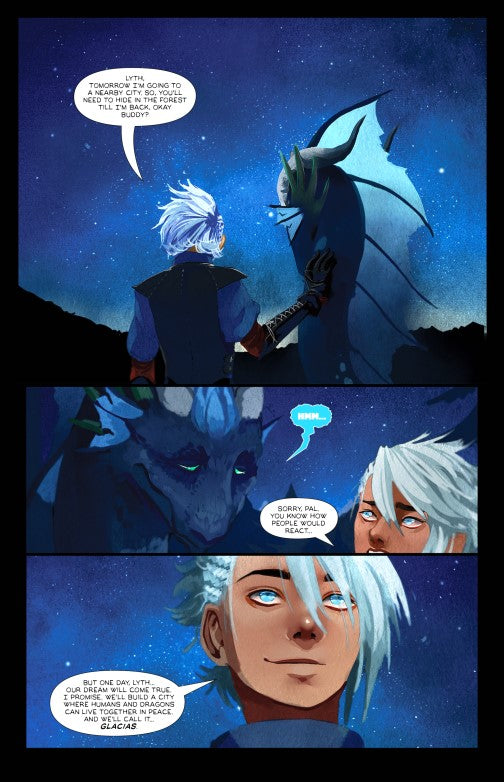
In Glacias, written by Yaruno and illustrated by Nawa, Juka faces a different limit on a life he wants to share. In the opening issues’ published preview, he tells Lyth that a visit to a nearby city means the dragon must remain hidden in the forest. Juka rests a hand against him beneath a starry sky, apologizes, and acknowledges how people would react.
Then he promises a city where humans and dragons can live together. The friendship already exists. What it lacks is a place where the two can participate in ordinary life together. Building that place would change what their affection lets them do.
Beside Citizen Sleeper, the scene invites a question about the conditions surrounding a choice. Wanting a shared future is a beginning; making room for it is another undertaking. Otherworlds Inc. publishes Glacias. Explore the opening issues and read the preview on our Glacias page.
Something left for tomorrow
Citizen Sleeper makes maintenance consequential, then allows the meaning of a day to change as its demands become more manageable. That gives its early arithmetic a lasting importance. Every die spent keeping the body functioning belongs to the story of what that body might eventually be free to do.
The hopeful prospect is modest and substantial: returning to someone because you want to, putting effort into a project whose value lies beyond getting through the night, having enough capacity to risk an uncertain result. These possibilities require room. A life takes shape when survival begins to leave some of the day unclaimed.
Sources and credits
This essay concerns the original 2022 game and its early systems and situations. Creator interviews, official materials and published gameplay accounts inform the analysis.
- Citizen Sleeper — official publisher page — Fellow Traveller.
- How Citizen Sleeper was inspired by tabletop RPGs and gig work — Joel Couture interviewing Gareth Damian Martin.
- Citizen Sleeper — Steam store page — Jump Over the Age / Fellow Traveller.
- Gareth Damian Martin on creating more meaningful choices in RPGs — Origin Story; Phillip Russell and Ben Thorp.
- How the fight for bodily autonomy shaped 2022’s most fascinating video game — Robin Bea interviewing Gareth Damian Martin.
- Citizen Sleeper review — Jody Macgregor, PC Gamer.
- Citizen Sleeper beginner’s guide — tips to get you started — Tony Wilson, Gamepur.
- Play review of Citizen Sleeper — GIGAZINE editorial team.
- How to get and eat food in Citizen Sleeper — James Carr, Gamepur.
- Citizen Sleeper goes physical! — The Sleeper’s Archive — Jump Over the Age / Gareth Damian Martin.
- Citizen Sleeper (Original Soundtrack) — Amos Roddy.
- Glacias Issues 1–2 public product preview — Yaruno (story), Nawa (art); Otherworlds Inc. publisher.
- Official original-game skills screenshot — Jump Over the Age / Fellow Traveller.
- Official original-game Bright Market screenshot — Jump Over the Age / Fellow Traveller.
Game imagery: Citizen Sleeper © 2022 Jump Over the Age; published by Fellow Traveller. Character art: Guillaume Singelin. Glacias excerpt: story by Yaruno, art by Nawa; published by Otherworlds Inc.
Third-party promotional artwork is included for identification and editorial commentary. Rights remain with the respective creators and rights holders. Banner crops and title treatment by Otherworlds Inc. Contact Otherworlds Inc. for credit corrections or rights concerns.
Continue Exploring
Explore how games give everyday effort, care and creativity a place in their stories.

